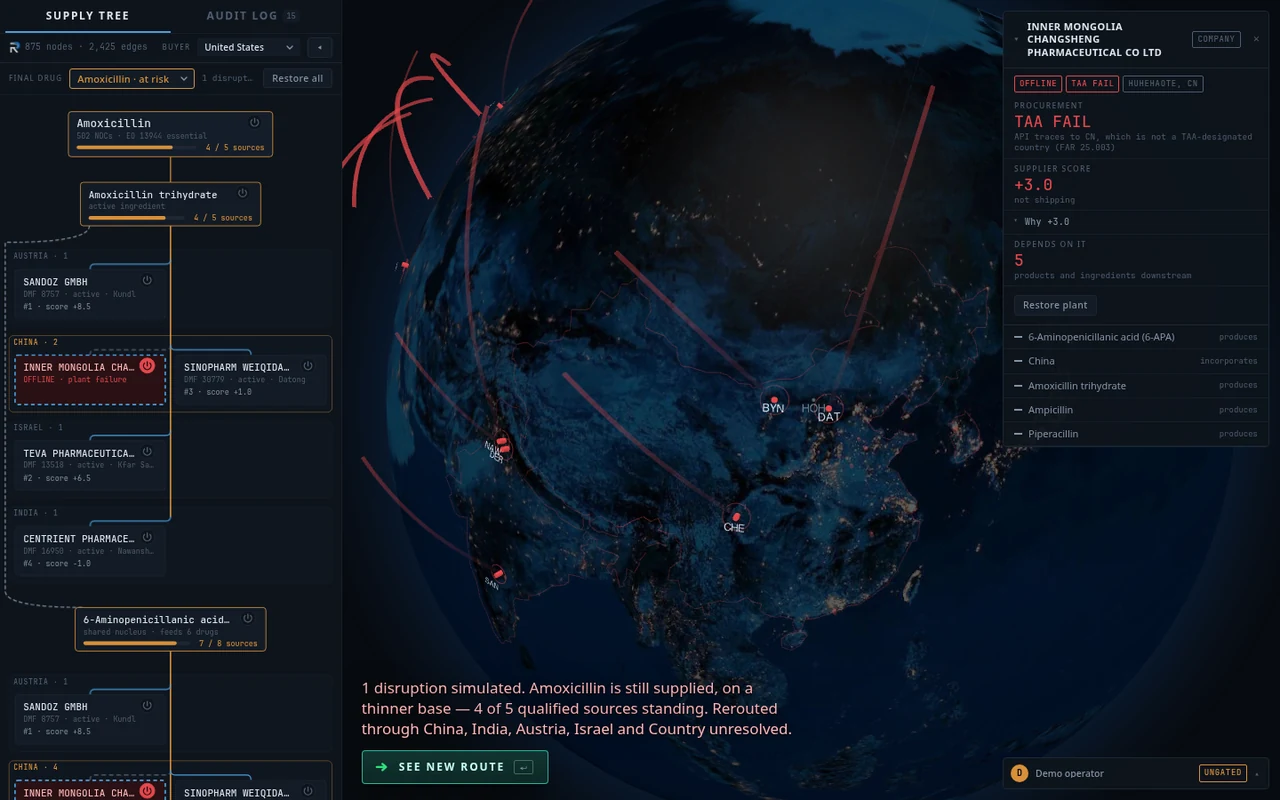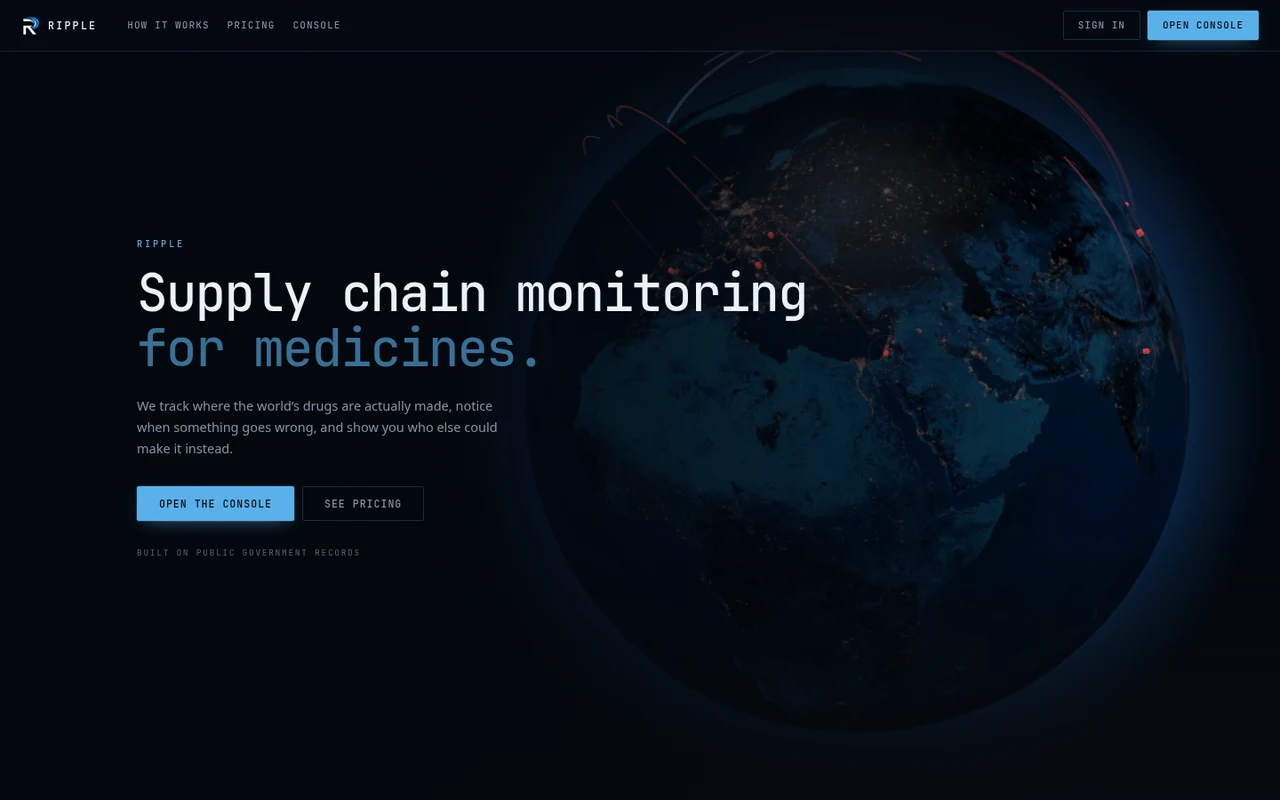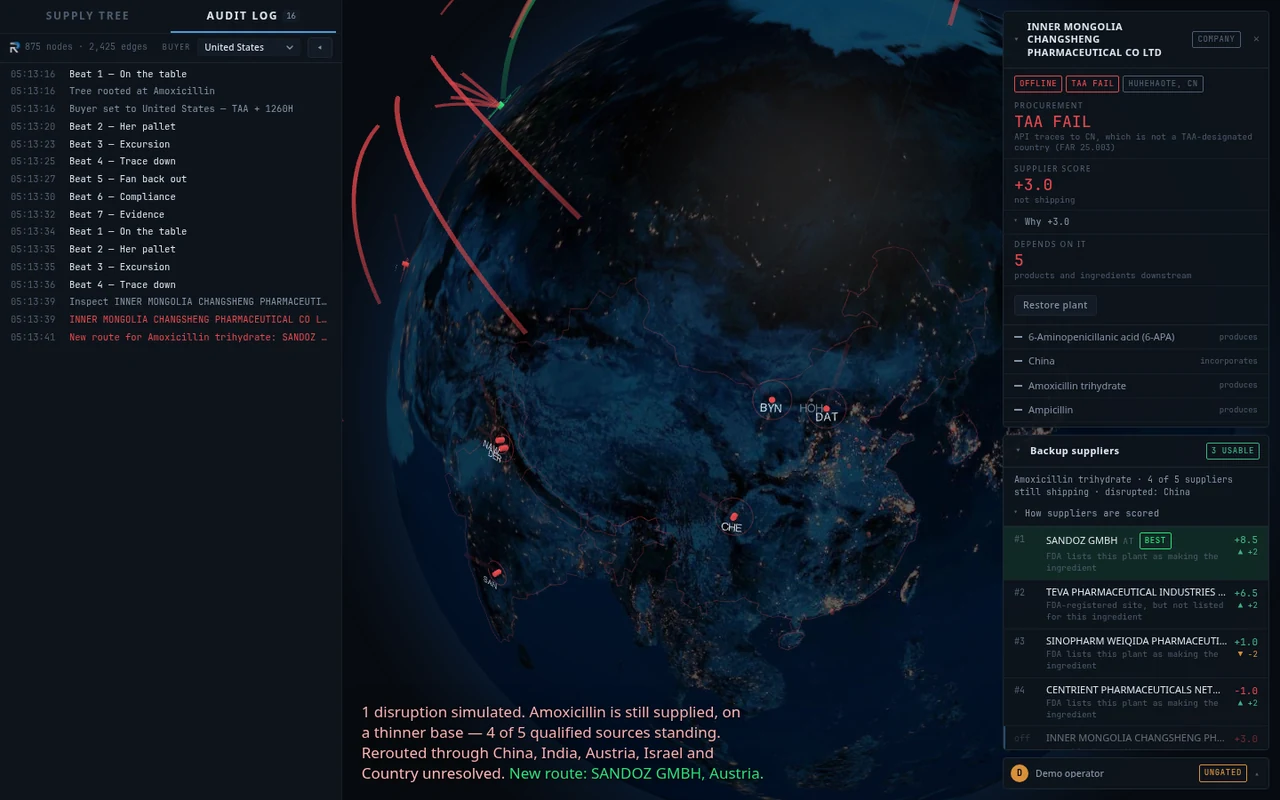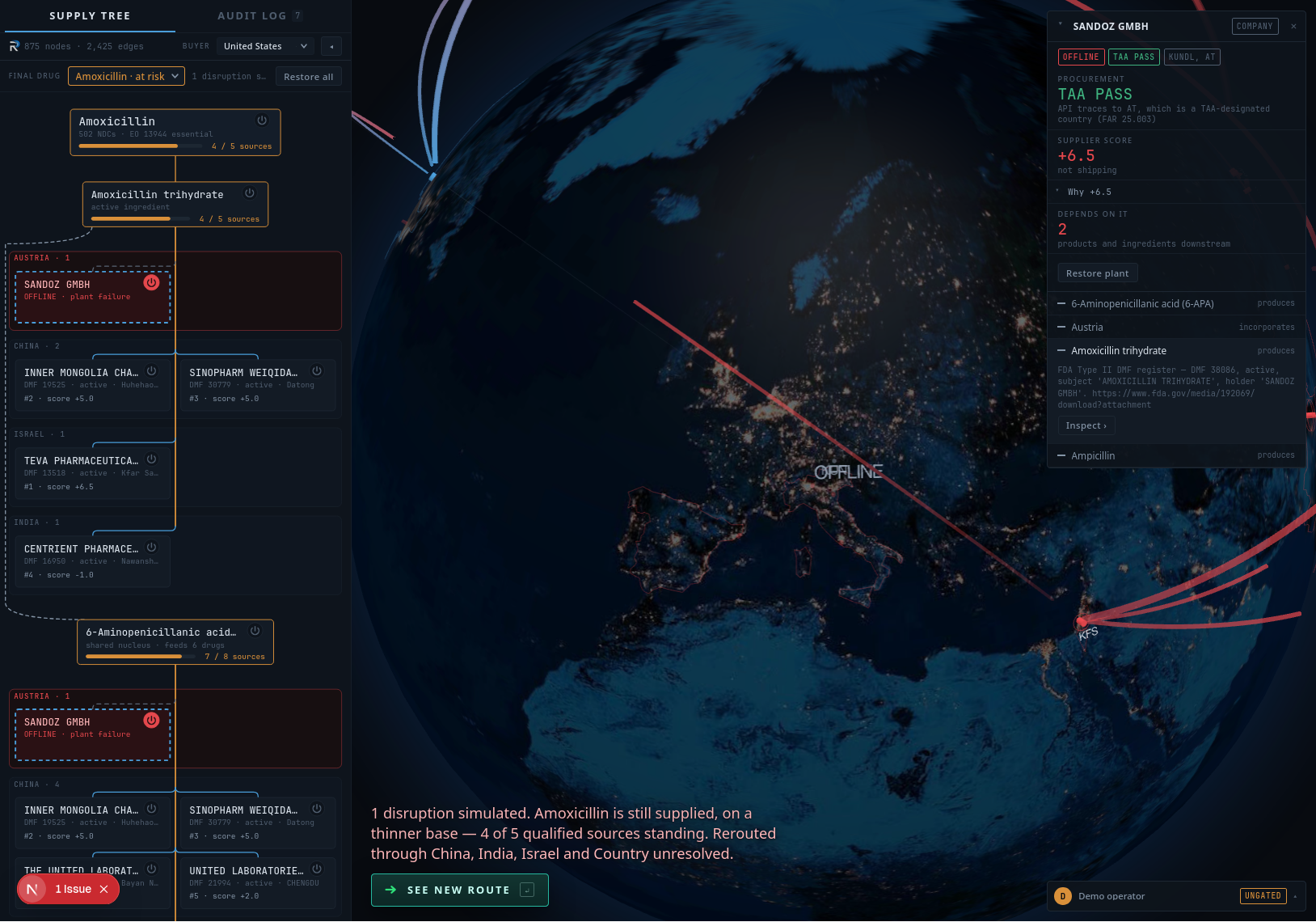
We built RIPPLE, a tool for supply-chain risk managers to see where their medicine supply is secretly exposed. Then we re-route and optimize the supply chain to mitigate US medicine shortages.
Problem
China and India make up ~88% of the world’s active pharmaceutical ingredients. Drugs that look diversified on paper (e.g. different brands, different labels) often trace back to a handful of overseas factories, and a shutdown at one of these points causes cascading damage. 323 active drug shortages hit an all-time U.S. high in early 2024, and 76% of the medicines that HHS, the DoD, the FDA, and the WHO all independently agree are essential are currently in shortage. Hospitals already spend over $1.1 billion a year and 20 million staff hours just working around empty shelves.
Solution
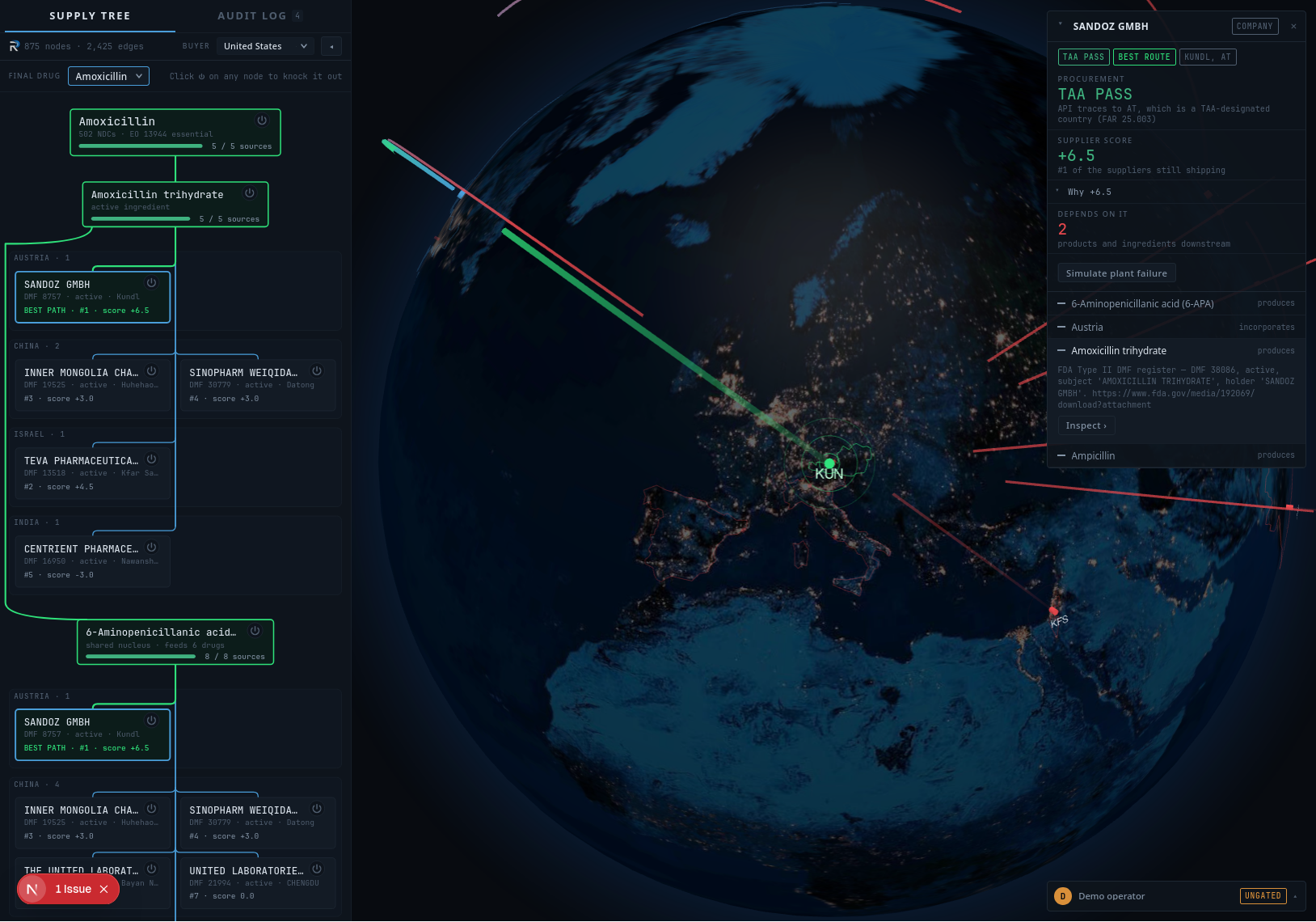
RIPPLE traces a drug down to its raw ingredient, then fans back out to show every other drug also exposed to the same source, using live FDA data plus a public filings registry nobody has cross-referenced before. A trained model predicts which plant is likely to fail next with 0.814 AUC, so a risk manager sees a warning before an inspection report ever would. Every supplier is scored PASS/FAIL against real federal procurement law (the Trade Agreements Act, DoD's restricted-companies list).
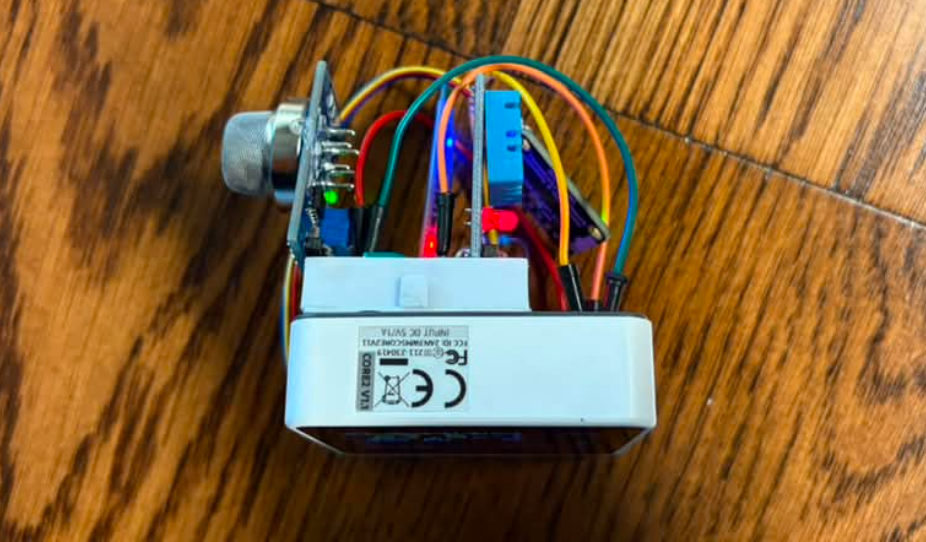
When one goes down, RIPPLE ranks viable backup suppliers, drawn from every company holding an active filing for the precursor behind that drug. Matching those company names, which are spelled differently across every government source, is where an agentic AI scored a perfect 100% on a labeled benchmark. Finally, a low-cost physical sensor rounds it out, catching a perishable shipment spoiling hours before a simple temperature reading ever would, and it's built to scale into a full monitoring network.
Algorithm Implementation
RIPPLE models the pharmaceutical supply chain as a graph built from public FDA registers, tracing each drug to its active ingredient, shared precursor, and the plants and countries that make it. Failure cascades propagate through BFS reachability and a k-of-n redundancy rollup, and a transparent rule engine with event-versus-state signal semantics decides when a node turns red. Supplier identity across registers is resolved with a token-normalized Jaccard matcher that refuses ambiguous ties, backed by a Claude tool-use agent that adjudicates only the pairs the rules refuse.
The per-plant risk score is an L2-regularized logistic regression trained on nine leakage-free features from inspection and import-refusal history, validated with temporal cutoffs, 5-fold cross-validation, permutation tests, and a baseline-beating shipping bar. Raw scores are calibrated with isotonic regression and reported with Wilson intervals so the percentage on screen matches observed frequency. When a plant goes down, a multi-criteria ranker shortlists alternates on DMF capability, DECRS registration, geographic diversification, TAA eligibility, and the alternate's own risk. An ESP32 node streams cold-chain telemetry to a FastAPI service that computes mean kinetic temperature and pushes state changes over server-sent events for depots.
Impact
RIPPLE belongs in the hands of a Group Purchasing Organization or HHS Risk Officer, somebody who gets an early warning for a risk and catches a chokepoint before it becomes a shelf-empty emergency. More broadly, modeling essential medicines this way means the country isn't flying blind on its own drug supply. If a key plant or country ever became unavailable, whether from a disaster, a geopolitical shock, or a deliberate cutoff, decision-makers would already know which drugs are exposed and where the viable alternatives are, instead of scrambling to find out during the crisis itself.