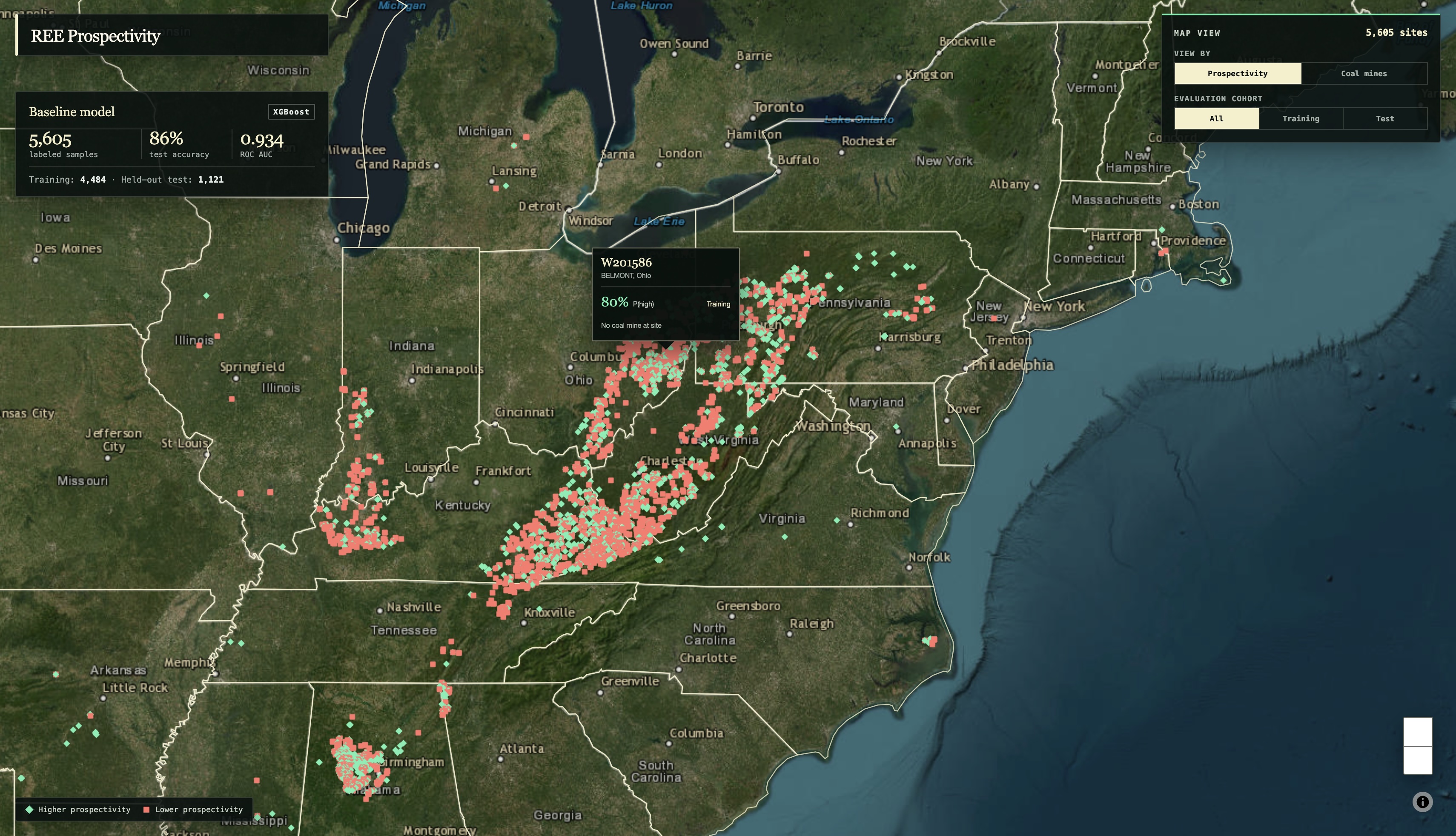
Rare Earth Elements are critical to modern technology and defense, the essential inputs for the permanent magnets in electric vehicles, wind turbines, and systems like precision-guided munitions. Yet China mines about 60% of the world's REEs, processes nearly 90%, and makes 94% of the magnets that use them, while the U.S. remained 67% import-reliant in 2025. In response, the DOE is building a domestic supply chain from coal, committing roughly $75 million in July 2026 to pilot projects recovering REEs from coal and coal waste. The opportunity is large and untapped. The U.S. holds more coal than any nation, and DOE estimates unconventional coal-based sources could hold 11 million tons of REEs, dwarfing the 1.4 million tons of conventional reserves and largely unrecovered. But conventional REE exploration is slow and costs billions per operation over a decade or more. Coal data, by contrast, is abundant and free: the USGS COALQUAL database alone holds geochemical analyses for thousands of samples nationwide. The two are causally linked, as REEs are incorporated into coal and its clays during peat accumulation, so routine coal-quality parameters already measured at scale carry a predictive signal for REE enrichment. We exploit this by applying gradient boosting to national coal geochemistry, predicting REE enrichment from cheap, widely-available coal-quality measurements rather than costly dedicated assays. The result is a detailed map of predicted REE concentrations across U.S. coal, a screening tool that points scarce recovery resources toward the most promising deposits first.