Bedrock Analytica
Making concrete self-sensing to industrialize American infrastructure at scale.
Problem & Impact At Bedrock Analytica, we make the concrete material itself the sensor. America is about to pour a staggering amount of concrete: $77.7B in data center starts in only 2025, a record 86 GW of new generating capacity planned for 2026, and massive investment in nuclear, semiconductor, and renewable infrastructure. The problem is that we’re trying to industrialize construction without industrializing measurement. In manufacturing, every product is continuously measured so defects can be caught and production can move faster. Construction has no equivalent feedback loop. Once concrete sets, we lose visibility into what’s happening inside it. That makes verification the bottleneck. Every critical pour must be inspected, tested, or certified before the next stage can confidently begin. You cannot accelerate a schedule you cannot measure. Half of US data center projects have been delayed 3+ months, while structural monitoring can cost $1M+ per bridge using discrete sensors and manual inspections. Bedrock makes monitoring 80% cheaper while generating continuous, dense data throughout the structure. China has mandated structural monitoring for decades and now has 30 nuclear reactors under construction—more than the rest of the world combined. America, to win, needs its own cheap path to speed, and Bedrock is that. What Bedrock Does - Technicals
-
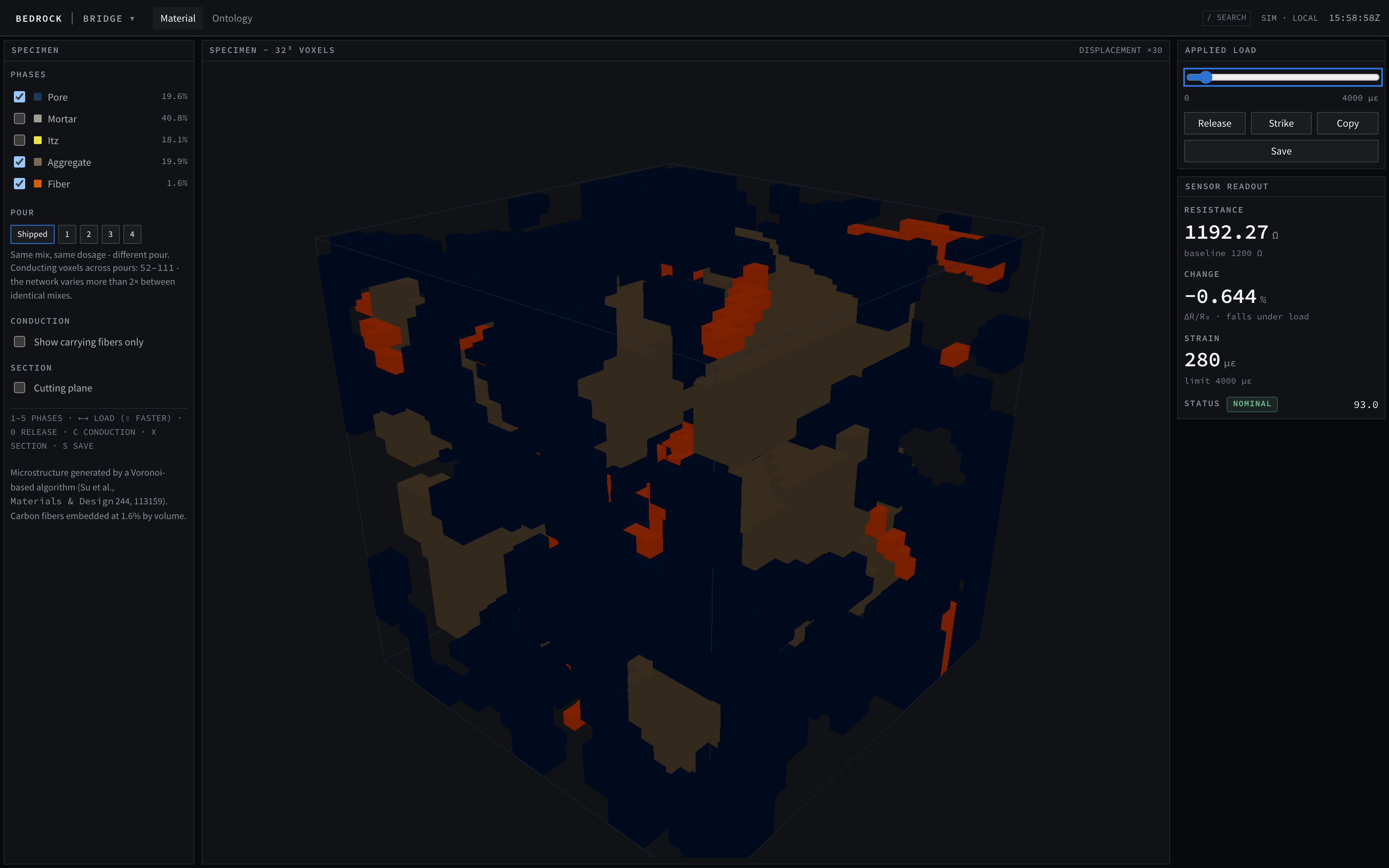
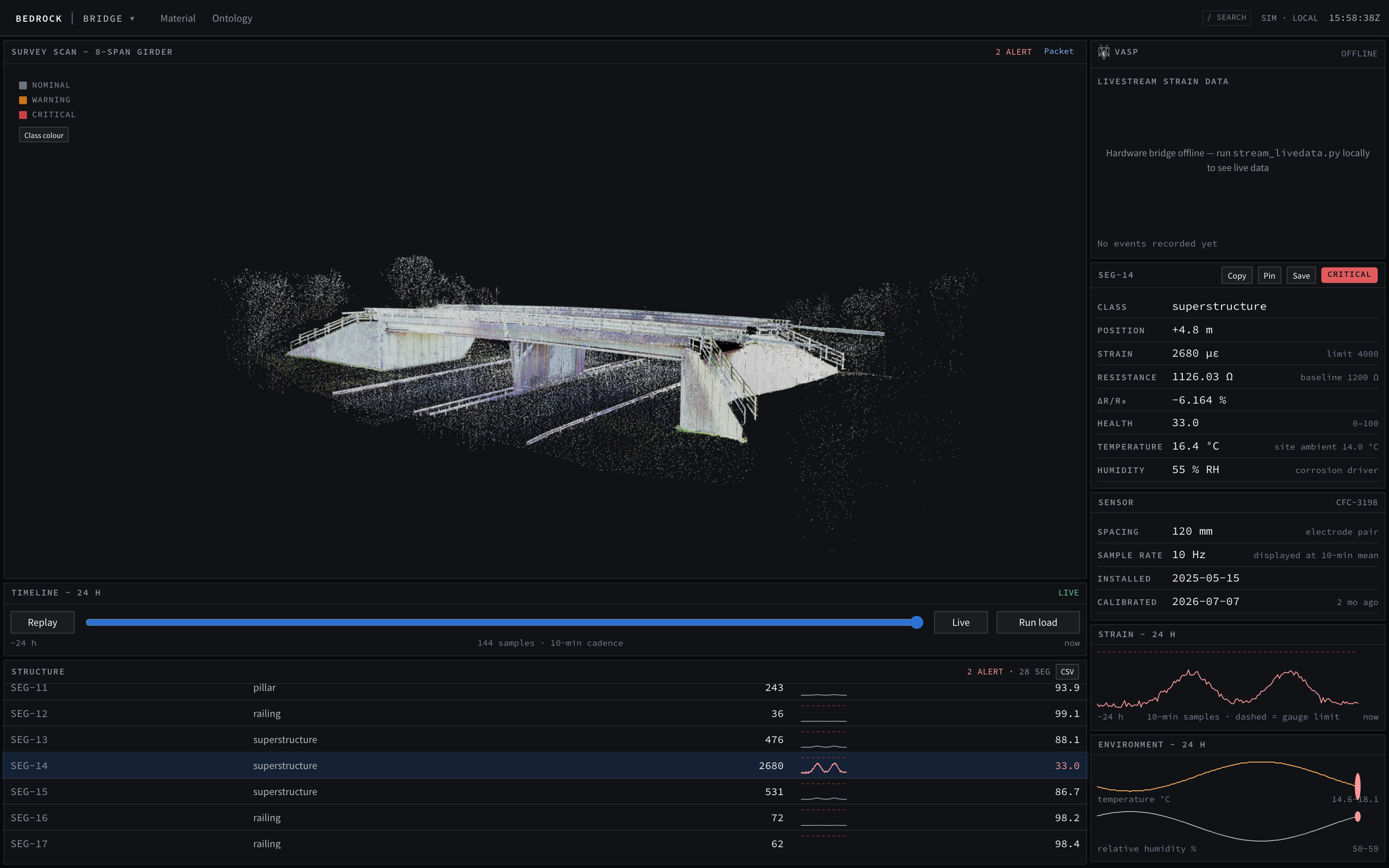
The specimen is the instrument. A carbon-fiber mortar cube with four copper leads cast in forms the fourth arm of an AC Wheatstone bridge on a Digilent Analog Discovery. Load it, the internal fiber network compresses, resistance falls, and the bridge goes off balance. We read that at 10 kHz. Nothing is bonded to a surface and nothing is buried in the pour, so nothing inside the structure dies before the concrete does.
-
Recycled carbon fiber at roughly 0.5 wt%, mixed in during ordinary batching. The fibers form a conductive network through the whole pour, so the sensing volume is the structural volume. A discrete sensor reads the one spot you put it. Ours reads everything the concrete touches.
-
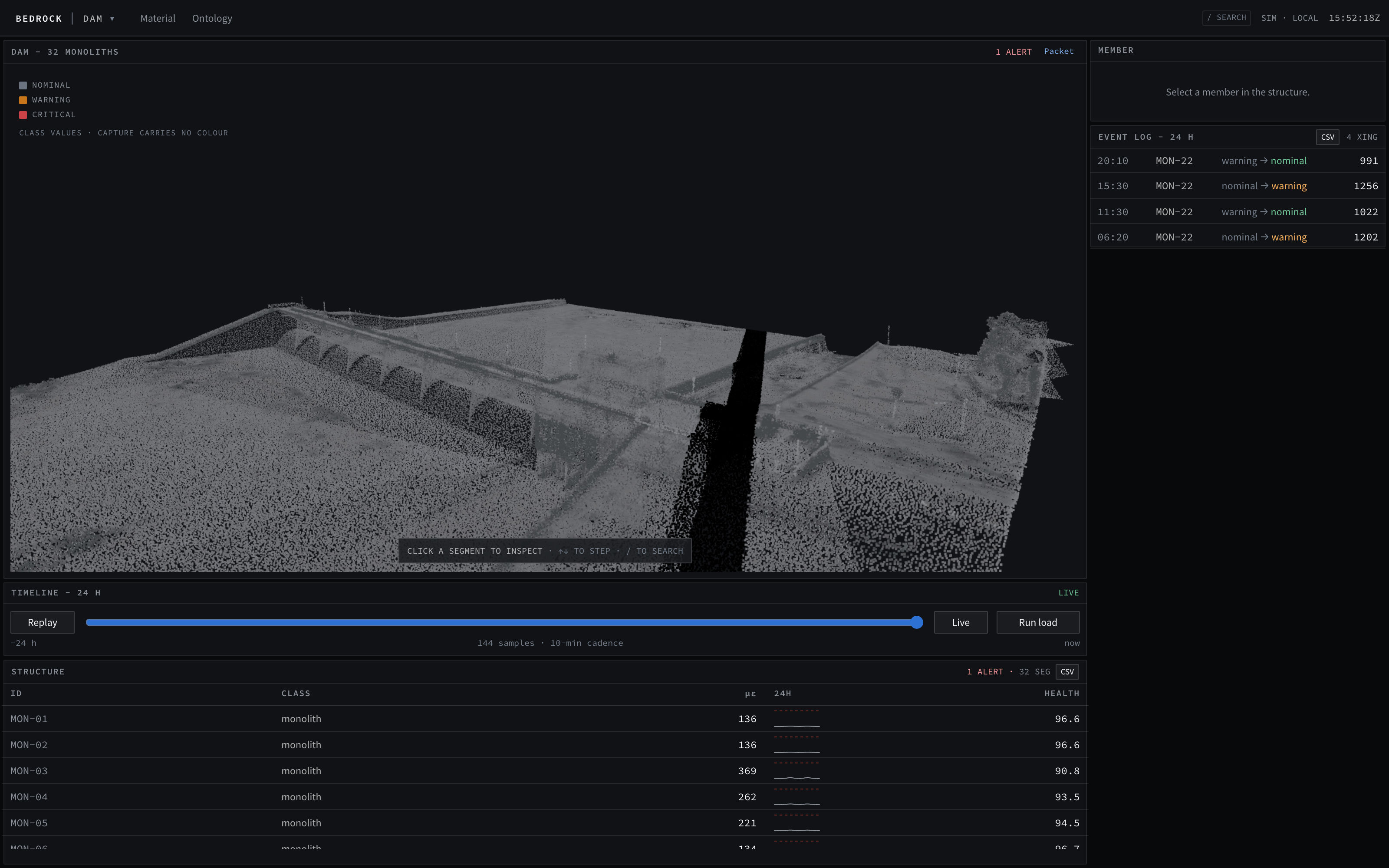
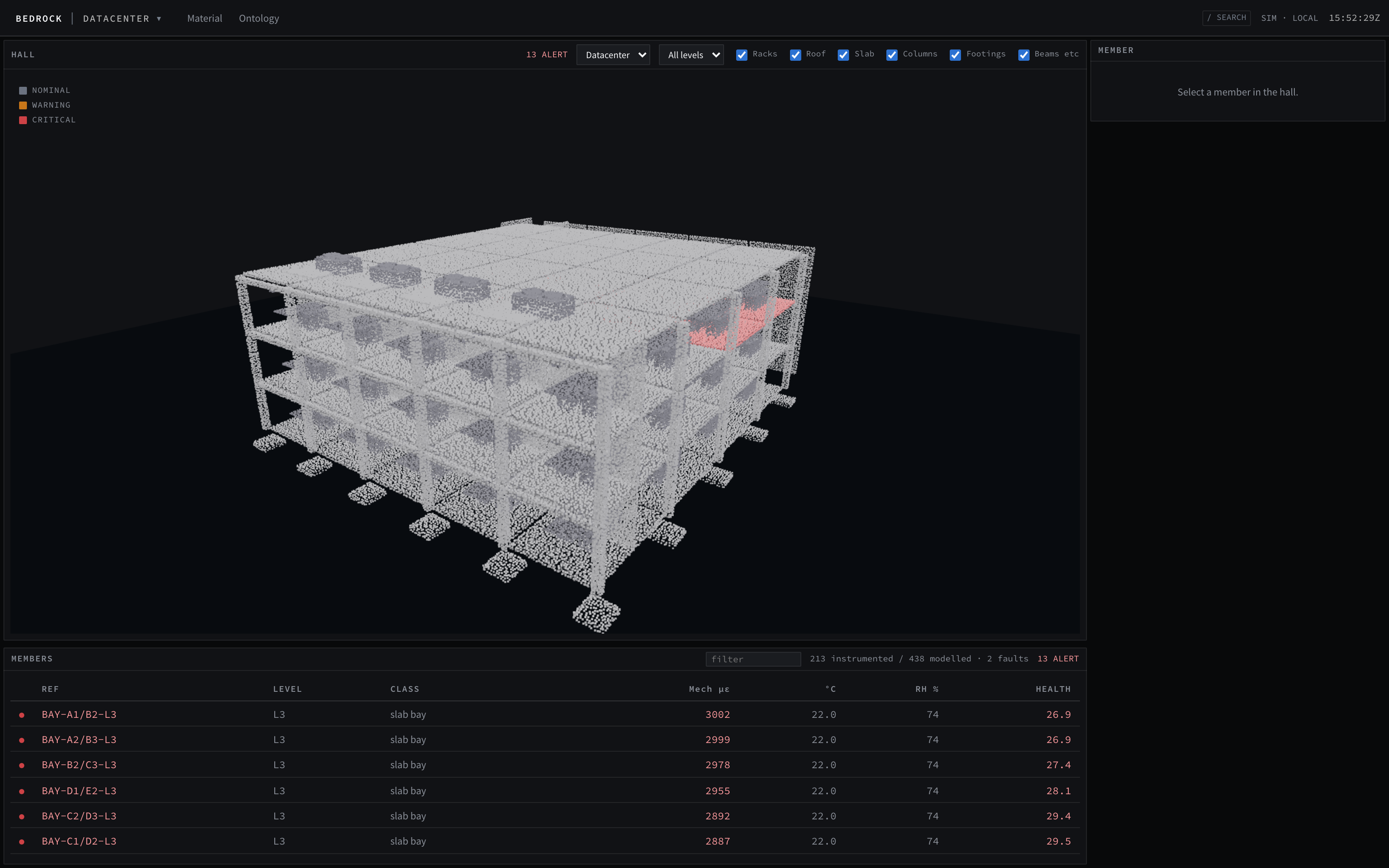
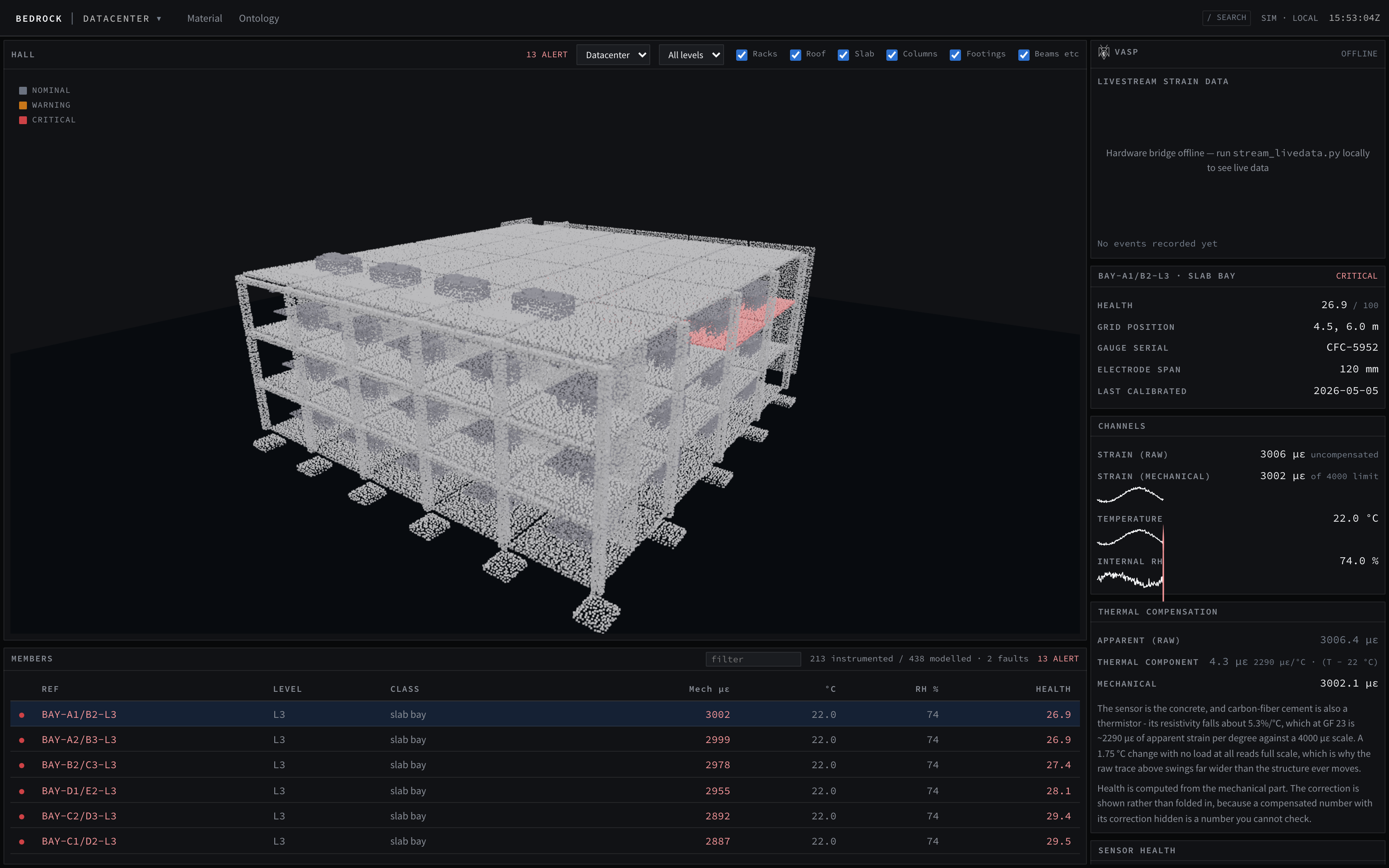
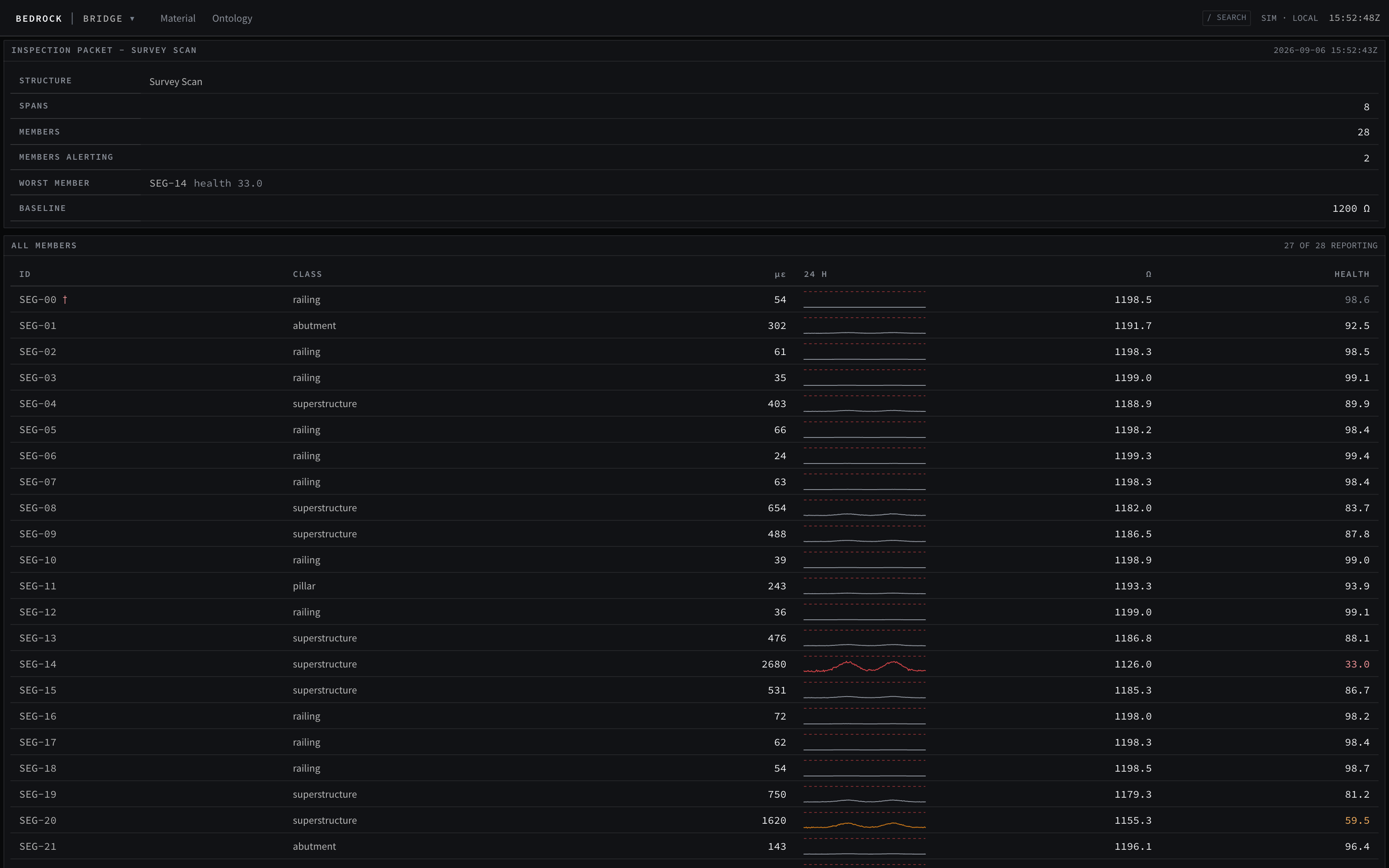
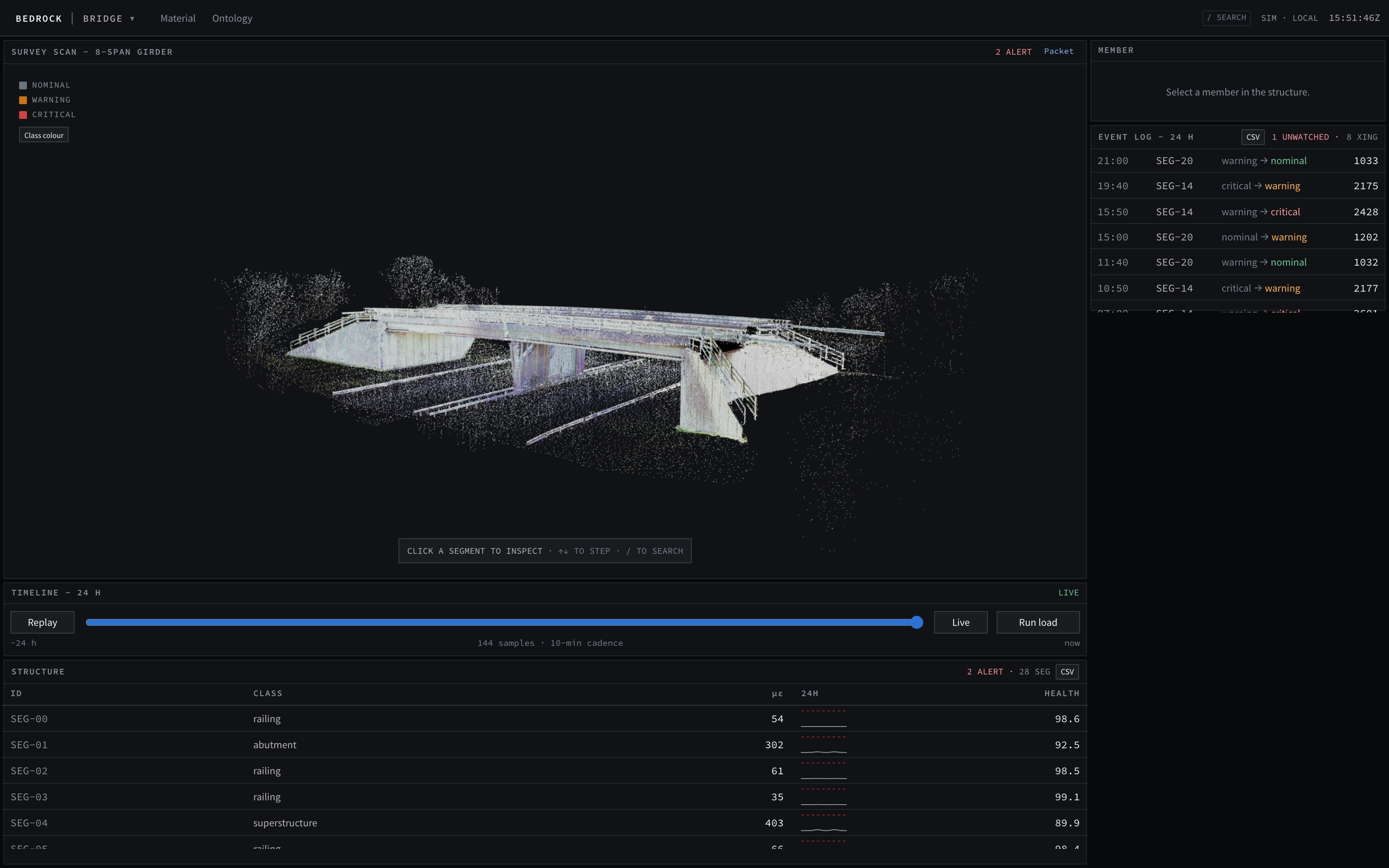
Live load moves a digital twin. The bench signal streams over a WebSocket into a twin of three laser-scanned structures: a bridge, a gravity dam, and a data center. 3,826,902 surveyed points, 273 addressable members. Press the cube and the member lights up. Cross a threshold and the system opens a hazard, writes the inspection record, and projects the date that member hits its limit. Next.js 16 static export, 117 Playwright checks.
-
The system knows when to distrust itself. Every member is cross-checked against same-class peers under identical loading. Our failing bay reads 6.65× higher than its three neighbors. A dead gauge sits at 0.0057, about 45× flatter than any live channel, and we mark it offline rather than healthy. Most systems read a quiet sensor as good news. Unmeasured is not the same as healthy.
-
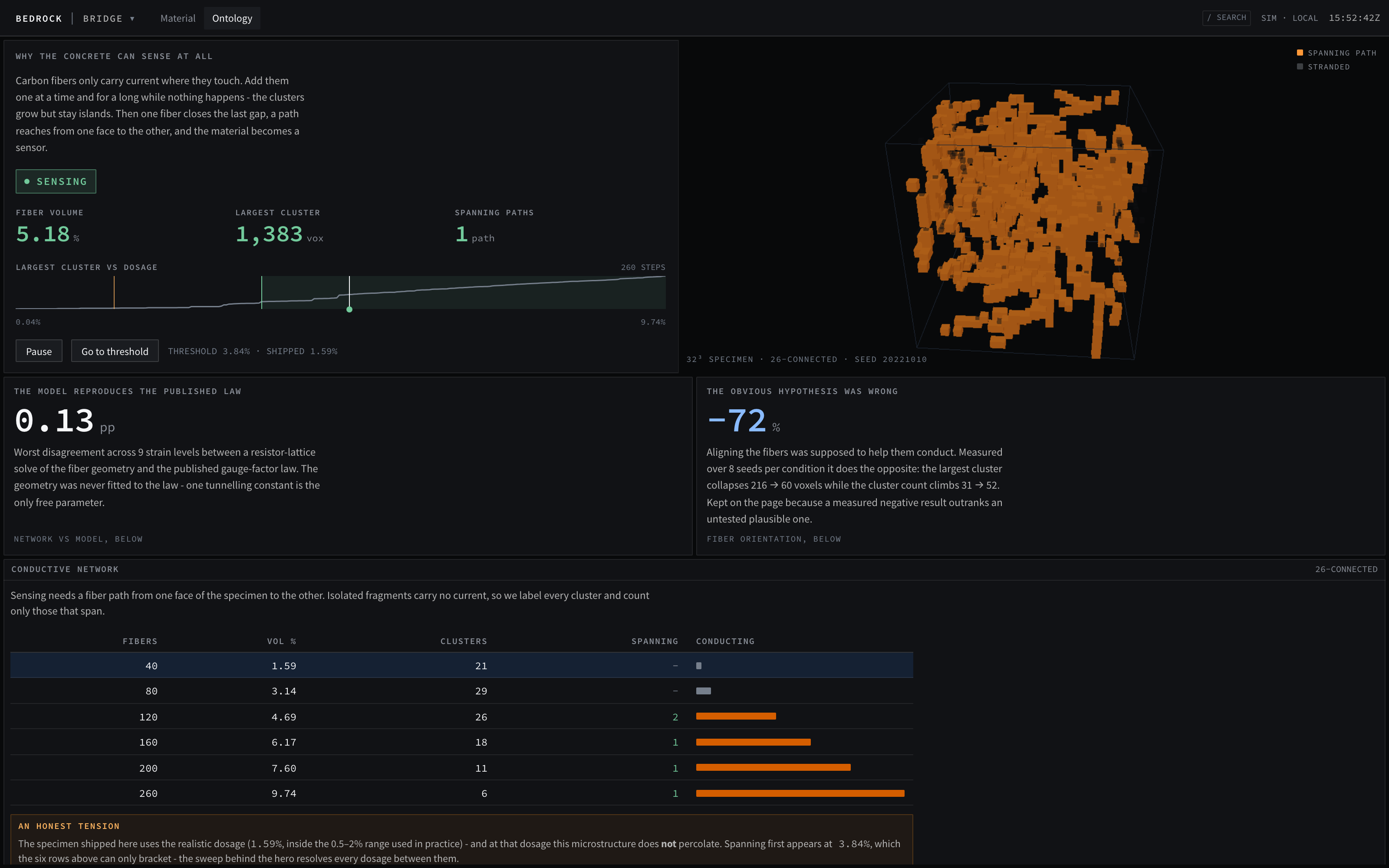
Every number traces to the microstructure. A Python pipeline models a 32×32×32 voxel volume of pore, mortar, ITZ, aggregate and fiber, then solves the conductive network inside it. Spanning onset lands at 3.836% fiber by volume, and a 32,768-node resistor lattice matches the published gauge-factor law to within 0.13 points across the full 0 to 4000 microstrain range. Microstructure to conductivity to structural response to anomaly to twin to inspection decision, with no fitted curve anywhere in the chain.
Feasibility & Deployment Bedrock fits into concrete pours that are already happening. Adding ~0.5 wt% fibers to concrete doesn’t change how a structure is designed or built and there are no electronics inside it that could fail. At ~$7K per instrumented segment and ~$4K per structure per year for monitoring SaaS, it’s cheap enough for everyday infrastructure. We spoke with 3D-printed construction firms, precast tunnel producers, and offshore energy manufacturers, and they all identified the same problem. They have no way to track the quality of their structures to improve their construction process, or prove their concrete’s performance to customers or regulators. Bedrock gives them that data. Integration is straightforward because we simply mix into concrete the companies already make on their own. Critical infra and automated construction companies are our wedge into the market, as monitoring and data collection provide immediate economic value. Current regulation requires periodic inspections, so our continuous monitoring already meets that.